Chapter Four: - Into The Void
“There’s a classroom full of kids back there!”
“What did you see?” asked Trisha.
2:20:03 p.m.
KCOT
Jenkins paused for a second, listening to the strange sound yet again, thinking before answering. “You need to see this. It’s… I don’t know, it’s creepy.” He stared into Trisha's eyes. “There’s a classroom full of kids back there!” “What?” said Trisha, not sure what else to say. Like Jenkins, she had noted another child gone — the desk where Julie Rowe sat now vacant. Seven of us left plus Samuels, she thought, her heart pounding.
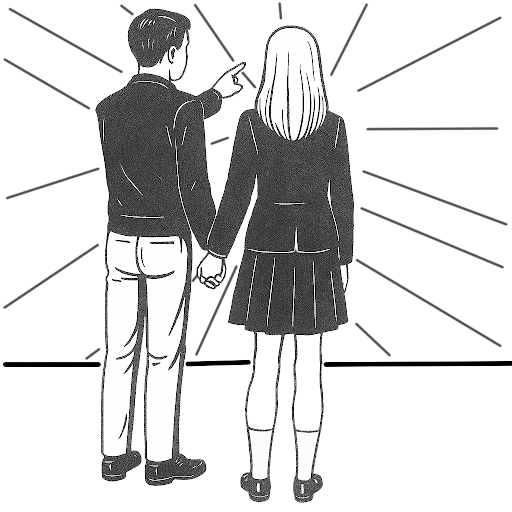
“Come on, you need to look.” Jenkins held out his hand. “Really?” said Trisha, scared. “Come on, it’s only you and me.” He held out his hand, which Trisha took, receiving a firm confident grip. Together they walked toward the whiteness, Jenkins in front, the remaining seven children occasionally looking at them.
Trisha watched as his head, then his body and arms disappeared through, and then her own arm vanished as she stepped through with him. They both gasped. A brief sensation of static rippled through them alongside a blanket of dampness, and they found themselves in the classroom — the same classroom, but different.
It was bleaker, if that was possible. Darker. The desks, now all single ones, each one with a young child sitting there looking despondent, all in smart school uniforms and with school caps firmly on their heads. The room was decorated in monotone green paint and a pervading atmosphere of gloom rushed over them both.
“It’s so silent,” whispered Trisha. “Not a noise from anyone, no breathing, no coughing. The only sound is the clock.”
Tick-tock.
“I wonder if it’s the same clock,” she said as she took in the rest of the room, there were fewer posters on the wall, more room for the headache-inducing monotone paint to show. And the same stuffed badger looked blankly, its teeth baring as if in continual pain.
Trisha noted the desks all had inkwells, and children of — maybe eight or nine — had their heads down and were working furiously, frequently dipping their pens into the inkwells. Ink-stained fingers worn raw from endless writing, deep marks in their skin where the heavy pens pressed against. Some nails were bitten down to blood, yet the pens scratched on silently. In the far corner one child was silently sobbing, head buried in his hands. She could guess why.
She looked behind — the whiteness wasn’t visible. Shit, where’s it gone? She hoped it was still there, wherever “there” was. Would she be able to get back to her classroom?
Where Kirsty had been sitting just seconds ago was a different face. Another small boy, maybe ten? He looked pale and sad, and Trisha could feel the despair coming from him as she watched him furiously writing mathematical formulas in neat ink, his other hand supporting his aching wrist.
She looked at the other faces in the room and didn’t recognise any of them. Keeping hold of Jenkins’ hand, she awkwardly attempted to pull her cardigan around herself with one hand. The room was freezing and Trisha could feel moisture in the air, on her skin, on her clothes. “Can you feel the atmosphere?” she asked Jenkins. “Yeah, it’s freezing,” he answered. “No, the atmosphere — it’s depressing, bleak. Can you feel it?” “Yeah, it’s creepy.”
He took a couple of steps further into the room. “Look at them, they can’t see us.” He waved a hand in front of the face of one child and received no response. “They’re ghosts?” he offered. “Or we’re the ghosts,” Trisha suggested. “Ghosts to them.”
“Well one of us is… or are, I don’t know.” Without pausing, Jenkins reached out his spare hand and casually passed it down on the head of a child. The child unaware of this, had his head down, working hard, please no cane today running through his mind endlessly. Please not today.
Jenkins’ hand passed through the oblivious child, a similar sensation of static leaving a short, uncomfortable tingle in his arm. “Well, I’d say they’re ghosts. Hopefully we’re still alive.” Jenkins said, shaking his head and pulling his hand back. The pair headed towards the rear of the room.
“Have you noticed their faces are changing?” said Trisha looking at the child Jenkins had just put his arm through. “Christ,” said Jenkins, taking in the now different looking child sitting at the desk. Slightly different uniform, same sad look on his face. As they looked around the room every few seconds, a child in a desk would be instantly replaced by another child, all doing labourious work, all suffering.
“The uniforms are the same, they change slightly but it's like every kid who has been in this classroom throughout the years, is still here, suffering.” The thought shook her. As did the silence in the room. Not a sniffle or a cough, no sounds of breathing or fidgeting. Just silence, broken only by the relentless tick-tock of that damn clock.
She did a quick count — thirty-five single desks, each one filled with a child, their head hunched over, writing, endlessly writing. Wrists that agonised, bodies that ached.
“Jenkins.” “What?” “That’s Samuels.” Trisha indicated the teacher sitting behind the desk. Samuels’ desk. “That’s Samuels,” she repeated, “but younger.”
Jenkins stared. “Christ, yeah.” Same nose, same scowling face, same frame, just younger. On the desk sat a newspaper, a lunchbox, and behind the desk, proudly leaning against the wall, two long thin canes. I bet you used to use them all the time, you old bastard, he thought.
“Is that the same clock as we have?” Trisha asked. “I dunno,” replied Jenkins. “Maybe.” “It looks the same. Why’s it ticking so loudly?” “Will you stop asking me questions I don’t know the answer to,” he stated, and keeping her hand held, walked to the back of the room where he pointed to a wall calendar. “Look, 1948?”
Trisha peered in. “1956?” she said. “What?” said Jenkins, looking again. “You’re right — but it did say 1948.” “It’s changing, like the kids. Like we’re flicking through time?” said Trisha carefully, not understanding the situation, just offering ideas. “Look,” she said, looking at the window which offered no outside view but only the whiteness of the void.
They both looked — the same whiteness they’d seen in their class. It was everywhere, enveloping all. “Shit,” said Jenkins under his breath. “That clock is getting louder,” said Trisha, as Jenkins exclaimed: “Calendar now says 1962!” She looked — for her, it read 1959. “Just Samuels, being consistent, but young,” said Jenkins. “Do you think he can see us?”
They stood still watching, as Samuels of forty years ago, with thick black hair slicked down hard, took in every slight noise in his classroom, always on the hunt. They watched as he picked up a piece of chalk and aimed a direct hit just above nine-year-old Morris’s eye.
Then the scene changed and Samuels was thrashing a boy at the back of the class, the child's screams obvious but no sounds forthcoming. Complete silence. Then the scene changed again, new children, Samuels back at his desk.
“Maybe it’s Samuels. He’s doing this?” suggested Trisha. “This atmosphere is awful. I feel like bursting into tears.” “I know what you mean,” said Jenkins. “I feel like hanging myself; And that clock is getting annoyingly loud. Let’s go back.” “If we can,” said Trisha.
Back to what though? she thought. Back to a room with vanishing kids no one has noticed. Back to a white emptiness taking over the classroom. Hands still held, they walked back to where the whiteness had been. They slowly took a step forward. Nothing changed. They stepped further — nothing. Another step.
They both felt the brief static and found themselves back in ‘their’ classroom, fractionally warmer and brighter. Samuels glaring at them, the remaining few kids ignoring them. Although the room was in silence, the usual hum of human noise flowed through it.
Looking around, they both looked at their watches. 2:27:47 p.m.
“Now Kirsty, Julie, Chris Morris and John,” said Trisha, looking around. “Four gone while we were in there. One to go, then you and me.” The whiteness had moved forward again, and now rested just behind the front row of desks, the remaining kids blissfully unaware of it.
2:28:03 p.m.
KCIT
The reverse sound snapped out, another empty desk. “It’s got to be something to do with Samuels,” said Trisha desperately. “Like he’s causing all this misery — our misery, all the kids he’s ever taught. He’s been doing it for God knows how many years. The earliest calendar date I saw was 1948, so at least thirty-five years.”
She only realised she was still holding Jenkins’ hand when he let go and stormed over to Samuels’ desk. Banging his fist down, he shouted, “What the hell are you doing, Samuels?”
Samuels looked startled. What the hell. Damn you, Jenkins. Oh, this boy will soon be in borstal. But that didn’t help him right now with a strapping fifteen-year-old threatening him. He looked around his diminished class. “Someone help,” he begged pitifully, pushing himself as far back in his chair as he could.
No one responded.
“We can see that white wall. You walked through it earlier — we walked through it and saw you, forty years ago, with your canes!” Jenkins was shouting, spittle spraying towards Samuels as he spoke.
Samuels pulled a handkerchief from his pocket, dabbing himself down. Spitting — that’s assault. Excellent, another thing to add to Jenkins’ crime sheet. “I don’t know what you are talking about, Jenkins,” he spluttered.
Jenkins looked at Trisha. “What do we do? I could hit him?” Trisha shook her head. “I think he’s genuine — not lying.” “Why would you trust him?” Jenkins asked. “I don’t trust him. I just think he is genuinely unaware, just like everyone else. But he’s a key part of this, maybe? And that clock is still getting louder as well,” Trisha added, looking up at it. 2:30:03 p.m.
KCOT
“Andy Lamar’s gone,” said Jenkins in a whisper, as the backward sound faded. “Me next.” “Keep looking at me,” said Trisha, who was closely following her watch, counting off each second — her counting matching the rhythm of the clock in the background, growing louder. “Maybe if we’re looking at each other?” she added desperately. “Sixty seconds to go.” “That won’t work,” said Jenkins. “I was looking at Andy Lamar when he went? Why is that bloody clock so loud?” “It must mean something,” said Trisha, still studying her watch. “What if we swap desks?” suggested Jenkins, a wry smile on his face.
”Oh, charming,” replied Trisha. “What a gentleman.” “No, I just mean if I have another two minutes maybe I can give Samuels a good thumping, smash him up. Maybe that’s what I should do now — better than listening to that bloody clock ticking like that.”
“Thirty seconds,” counted Trisha as she saw Jenkins move back towards Samuels, fists clenched. “No!” she shouted. “Grab the clock. Smash the clock.” “What?” said Jenkins. “Smash it now — quick. That sound, it’s the tick of the clock, but backwards.”
Worth a try, he thought, and quickly stepped up to the desk, and, shoving Samuels’ chair over with Samuels still in it, climbed up and grabbed the clock from the wall. Its tick tocking was so loud it was making the clock vibrate in his hands. He hurled it to the ground and it landed with a satisfying crash, the glass front shattered.
TICK TOCK. TICK TOCK. It shouted, undamaged.
Shit, thought Jenkins. “Hurry up!” shouted Trisha. “Seven seconds.”
If this doesn’t work I’m gone, he thought in alarm as he jumped down from the desk, the heel of his trainer landing square in the middle of the clock face. He felt the glass smash further and stamped down repeatedly, feeling the clock dismantle under his foot until finally—
Silence.
The ticking stopped. The clock lay smashed.
Two things happened. The whiteness moved forward again, now resting a few centimetres from the front of Samuel's desk. — The classroom door silently opened.
Trisha didn’t wait. Keeping next to the wall she rushed towards the door, grabbing Jenkins’ hand on the way. They both stepped over Samuels, who was on the floor half in, half out of his chair, spluttering and raging. They rushed through the door and as they passed felt the same static sensations as earlier.
Behind them the classroom door slammed hard. Jenkins glanced back as he ran and saw the whiteness covering the door entirely.
“Let’s get out of here,” he said and together they bolted.